Newborns sleep 14–17 hours a day, but in fragments — a 2-hour nap here, a 25-minute catnap there, with no respect for day or night. Their circadian rhythm literally hasn't developed yet, so chasing a fixed schedule in the first two months mostly produces frustration. What works instead is a simple repeating loop: eat, play (briefly!), sleep — with a wake window of only 45–75 minutes, including the feed.
Watch the clock less and the baby more: the first yawn, pink eyebrows, or a glazed stare mean the window is closing now. An overtired newborn is dramatically harder to settle than a drowsy one.
Fixing day-night confusion
Many newborns sleep beautifully all day and want to socialize at 2 AM. You can gently speed up the fix:
- Flood the day with light — naps in normal daylight and household noise, not a blacked-out room.
- Keep nights boring — dim lights, quiet voice, no play, straight back down after feeds.
- Wake for daytime feeds if a day nap stretches past ~2.5 hours (ask your pediatrician about your baby's specifics), so the longest sleep stretch migrates to nighttime.
Most babies sort out day vs. night by 6–8 weeks.
When can you start a real schedule?
Around 3–4 months, sleep cycles mature and a genuine rhythm emerges — usually a predictable morning nap first. Until then, protect the wake windows, repeat the loop, and lower the bar: a "good" newborn day is one where nobody got overtired, not one that matched a chart.
Schedules are averages.
Your baby isn't.
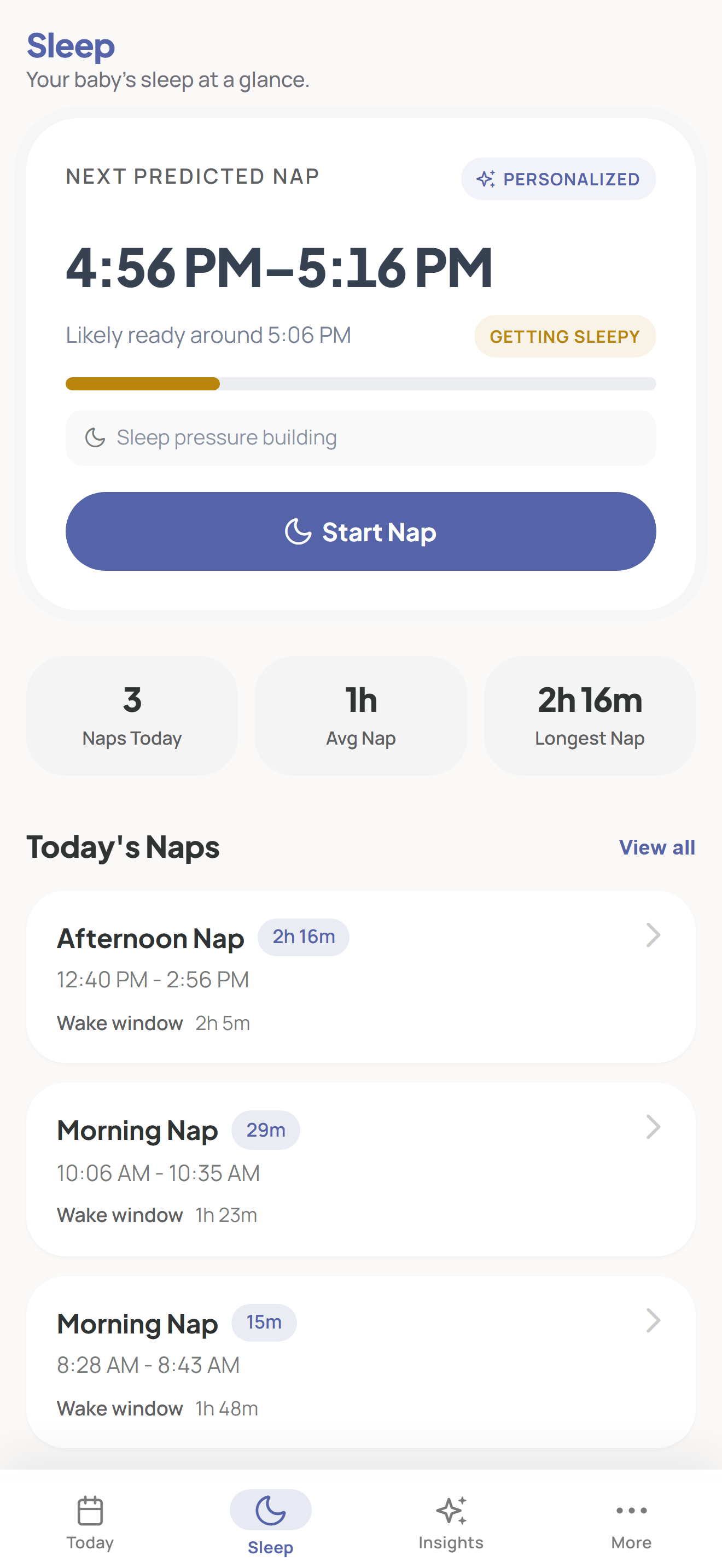
LunaLog learns your baby's actual rhythm from the naps you log and predicts the next nap window automatically — no mental math, and it updates itself as wake windows grow. Free to start, and both parents stay in sync in real time.
Try LunaLog free